

Object Record
Images
Additional Images [2]
Metadata
Object ID # |
2009.001.001 |
Object Name |
Machine, Type Casting |
Title |
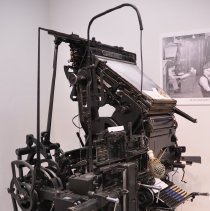
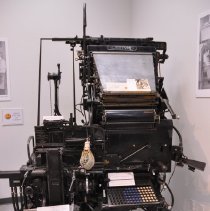
Model 29 LINOTYPE Machine |
Lexicon category |
6: T&E For Communication |
Date |
Likely 1950s |
Year Range from |
1951 |
Made |
Mergenthaler Linotype Co. |
Place of Origin |
New York, New York, United States of America |
Description |
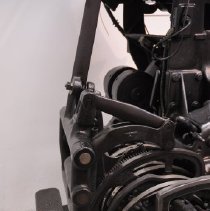
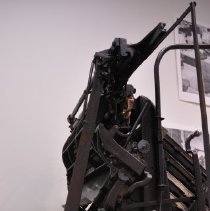
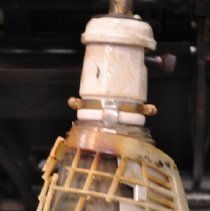
LINOTYPE machine, Model 29, No. 66592. It is 173 cm wide at the front. It was given a number "5" at the top and has an embossed label identifying a linotypist who ran it, "MARSH HAINES NO. 5". The "Pi Channel" on this machine has two metal clips beneath it. The front has an electric lightbulb inside a once-white plastic protector. The lightbulb is in a white porcelain socket. The top has spaces for four metal magazines to be installed. Magazines were where the fonts were stored. The fonts are on brass matrices (mats), inside the magazine channels. |
Makers mark |
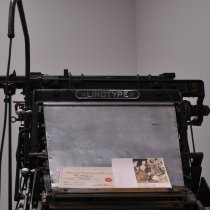
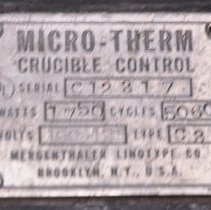
Rectangular metal plate affixed: "LINOTYPE / MODEL 29 NO. 66592 / MANUFACTURED BY / MERGANTHALER LINOTYPE CO. / NEW YORK, U.S.A. / ORIGINATORS AND IMPROVERS / OF THE LINOTYPE" A label near the crucible has: "KENDALL METAL FEEDER / COPPING HOIST CO. / DANVILLE ILL. 566" [number is hard to read] |
Provenance |
Manufactured by the Mergenthaler Linotype Co. of Brooklyn, New York. Likely dates to the 1950s. It was operated for many years by Marshall Haines, in Owen Sound, Grey County. It may have been used at the Sun-Times newspaper office. It was last owned by Richardson, Bond & Wright. This printing company was located in Owen Sound, and was often referred to as "R-B-W" or "RBW". In the late 1970s and early 1980s, Nels Maher and Wayne Landen worked towards the collection of vintage printing equipment, in order to provide a period building print shop at the County of Grey-Owen Sound Museum. |
Collection |
Printing & Bindery Equipment, 20th-c Collection |
Material |
Metal/Plastic//Brass/Glass/Porcelain [also contains Lead] |
Dimensions |
W-173 cm |
Found |
Owen Sound, Grey County |
People |
Haines, Marshall |
Subjects |
Letterpress works Printing industry Printing |
Search Terms |
Richardson, Bond & Wright (see RBW) RBW Owen Sound Sun Times |
Function |
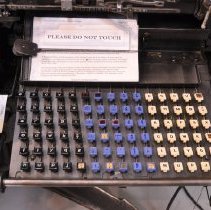
A "Linotype" is a machine that cast lead slugs into lines of type that could be used for letterpress printing purposes. It has a crucible that heats to a high temperature in order to melt lead from a "lead pig", that would be added to the machine. Electric metal pot heataing replaced previously-used gasoline and kerosene heating in 1915. In 1931, Linotype developed a mechanical thermostat. The previously-cast lines of type could also be re-melted and used again. The linotype has "magazines" inserted into it at the top. When not needed, the magazines would be stored vertically in a rack. The "Elevator" takes mats back up high for the distribution process. One internet site mentioned that the distribution was a "Circulating Matrix". Nels Maher said that each magazine has 96 channels inside it (some old linotypes had 90 channels, c. 1918 ones had 72 channels). Each channel holes a group of matrices (known as "mats") for one character. When the linotypist pressed a key on the keyboard, a brass mat would drop from the selected channel. The mat characters molded the lettering on the line of type, and the newly cast slug would be cut and trimmed, and the individual lines would be assembled and kept in order to the left of the front of the machine, on an inclined tray. This particular model, Model 29, was reportedly good for work where the composition involved the need to frequently change faces. It also had a continuous distribution feature. The "Pi Channel" is where mats rejected from the re-distribution process would go, so that the operator could make sure they went to the proper magazine channels or were replaced. |