

Object Record
Images
Metadata
Object ID # |
1989.015.006 |
Object Name |
Pick, Mill |
Title |
W. & J. G. GREEY Millstone Furrow Pick |
Lexicon category |
4: T&E For Materials |
Date |
post-1888 |
Year Range from |
1888 |
Year Range to |
1950 |
Artist |
Greey, W. & J. G. |
Made |
W. & J. G. Greey |
Place of Origin |
Toronto, Ontario |
Description |
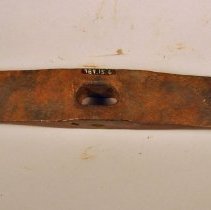
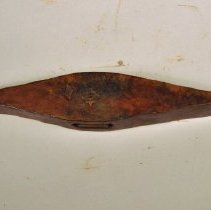
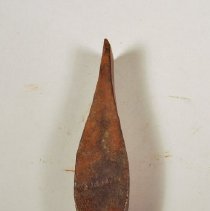
Double-ended, eyed-in-the-centre, tempered steel mill pick. This tool would have originally had a wooden handle (thrift) set into the eye. The tool head is 23.5 cm long. The tool was manufactured by the W. & J. G. Greey company. There are two impressed marks also present. The tool was formerly used at the Bognor Mill. |
Makers mark |
Impressed lettering shows that the tool was manufactured by the W. & J. C. Greey company. There are two impressed logo-like marks also present. |
Provenance |
Last owned by Elliott Shields of RR#8 Owen Sound, at Woodford, in Sydenham Township, Grey County. He told museum staff that the tool was formerly used at the Bognor Mill in Sydenham Township. The age of it is unknown, but the lack of a maker's mark suggests it pre-dates the 1890s. Bognor had both a flour mill and a shingle mill. In the 1860s, James Trotter and James Haig constructed a sawmill and a flour mill (three stories in height) on Lot 6, Conc. 2 of Sydenham Township. The properties were sold to Peter Quance in 1871. He constructed a new mill near the older grist mill. After changing hands several times, the grist mill was struck by lightning and burned to the ground in the summer of 1950 --- A HISTORY OF THE COUNTY OF GREY, p. 104 HISTORY OF SYDENHAM TOWNSHIP (1967), pp. 446-448. |
Collection |
Milling Tools & Equipment Collection |
Material |
Metal/Steel |
Dimensions |
W-4 L-23.5 D-4 cm |
Found |
Bognor, Municipality of Meaford, Grey County |
People |
Quance, Peter |
Subjects |
Gristmills Grey County Industry Grey County Industries Sydenham Township |
Search Terms |
Bognor Sydenham Township |
Function |
This could be called a millstone furrow pick, or a "mill bill". Millers needed to "dress" their millstones in grist mills in order to keep the grinding surfaces efficient. They used metal and wood hand tools to do this work. R. A. Salaman, DICTIONARY OF WOODWORKING TOOLS, p. 272 includes an illustration of a fellow using his tool to dress a millstone. |