

Object Record
Images
Metadata
Object ID # |
1982.060.045abc |
Object Name |
Plane, Howell |
Lexicon category |
4: T&E For Materials |
Date |
Pre 1911 |
Year Range to |
1911 |
Made |
Unknown |
Place of Origin |
Unknown |
Description |
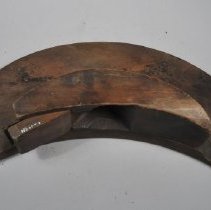
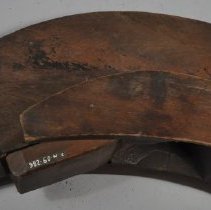
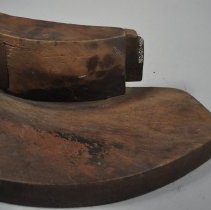
Also called a cooper's chiv plane (called a Howell or Howel Plane in the USA). Curving plane with a round-both-ways or compass-shaped sole, mounted on a stong fence. This fence is circular, thus following the shape of the cask end one which it will bear when in use; and it is sometimes placed to resist the abrasive action of the stave ends. A: Plane body (chiv). B: Blade C: Wedge. |
Provenance |
Maker unknown. Last owned by Victor Scheuermann (b. 1917 d. 1978). He had worked with his uncle William Scheuermann in the blacksmith shop at Lot 20, Concession 2, W.G.R., Bentinck Township, Grey County. William Scheuermann (b. April 5, 1885 d.1966) and Victor carried on the business. William Scheuermann's father (Victor's grandfather) was George Scheuermann (b. April 1, 1849, d. 1911). He ran the family's blacksmith shop first and also operated a cooper's shop (cooperage). George Scheuermann was been born in Germany, and emigrated to Canada in 1868. May have been owned/used by any of these men. |
Collection |
Woodworking Tools and Equipment |
Material |
Wood/Metal |
Found |
Bentinck Township (formerly), Municipality of West Grey, Grey County |
People |
Scheuermann, George Scheuermann, Victor |
Subjects |
Coopers |
Search Terms |
Bentinck Township |
Function |
Note: The word chiv is used for both the tool and the surface it is designed to cut. In the USA the surface is called the Howel. The purpose of the chiv is to make a smooth surface in the form fo a shallow depression near the top of the staves on which the croze groove will subsequently be cut. If this surface were left uneven, the croze groove would not be equal in depth all round, and the cask would leak. In use, both fence and sole are lubricated with linseed oil. In use, the chiv is held with one hand on the circuference of the fence (which is often shaped of grooved to protect the fingers) while the other hand grasps a handle which is usually fitted to the bottom of the stock. Chivs may be divided into the following groups: Chivs for wet casks, chivs used manly for dry casks (sloper), groper, flincher. |