

Object Record
Images
Metadata
Object ID # |
1961.027.022 |
Object Name |
Lancet |
Title |
CLULEY Gum Lancet with Tortoiseshell Cover |
Lexicon category |
5: T&E For Science & Technology |
Date |
19th-century |
Year Range from |
1813 |
Year Range to |
1850 |
Made |
Cluley |
Place of Origin |
Sheffield, England, United Kingdom |
Description |
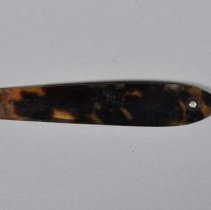
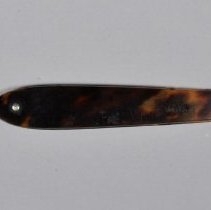
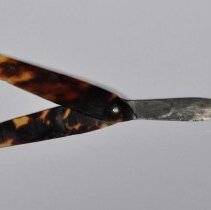
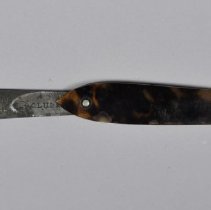
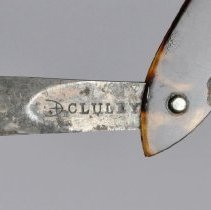
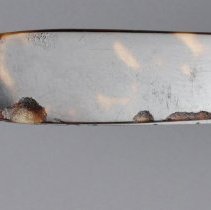
CLULEY pocket-sized lancet (likely a gum lancet) with a tortoiseshell cover, that is 19th-century item. When closed, the lancet is only 6 cm long. There is a short, tapered blade, which pivots out from a slim, pointed, tortoiseshell cover. The cover is very delicate. Near the join, the maker's name is impressed in the blade. Looks something like a "D" with a line bisecting it, and the word "CLULEY". |
Makers mark |
Near the join, the maker's name is impressed in the blade. Looks something like a "D" with a line bisecting it, and the word "CLULEY". |
Provenance |
William Sutton (b. 1811-d. 1894) used this lancet for dental work, etc. when he and his wife Catharine Sutton worked as missionaries in Canada West (later called Ontario). William originally came from Hornecastle [or Betchford], Lincolnshire, England, and apprenticed as a shoemaker. He emigrated at some point in the 1830s and became interested in becoming a missionary to the First Nations. He married a young Ojibwa woman, Catharine Brown Sunego, at the Credit Indian Village mission in the Home District, in January of 1839. The Credit Mission was located near the Credit River. The Suttons lived at the Credit Village until 1845, when they moved northward to join the Newash Band of the Ojibwa on the west shore of Owen's Sound. The Suttons were Methodists and did missionary work at the Newash Mission. Mrs. Sutton and her heirs were granted a quantity of land by the Newash Band, so the Suttons began improving her land for farming purposes. This area would later be known as Lots 32-33, Concession 3, Sarawak Township, Grey County. In the 1850s, the Suttons did some missionary work at Garden River for a time, but returned to their farm in 1857. In the 1860s, the Suttons continued to help Ojibwa people, and Mrs. Sutton travelled to England in 1860 order to obtain an audience with Queen Victoria in hopes of getting her to intercede with the Indian Department's poor treatment of aboriginals in Canada West. Mrs. Sutton passed away in Sarawak Township in September of 1865 and was buried on her property. Mr. Sutton continued to farm in Sarawak and preach in the area. Their farm land is now part of the Cobble Beach golf course in the municipality of Georgian Bluffs in Grey County. The lancet was passed down to a grand-daughter of the Suttons, Mrs. Alfred Morgan of Brantford, Ontario. Her husband, Alfred Morgan, was the last owner. The lancet's manufacturer was Francis Cluley of Sheffield, South Yorkshire, England. It would date sometime between 1810-1850, very likely in the 1813-1837 range. Cluley made lancets, trephination sets, obstetrical tools and other medical / surgical items. |
Collection |
First Nations, Sutton Collection |
Material |
Steel/Tortoiseshell |
Dimensions |
W-0.433 L-3.661 inches |
Found |
Brantford, Ontario |
People |
Sutton, William Sutton, Catharine Morgan, Catherine Morgan, Alfred Sutton, Catherine |
Subjects |
Surgery First Nations of Central Canada Turtles Medical equipment & supplies |
Search Terms |
Surgery Sarawak Township |
Function |
A lancet is a small surgical instrument, usually sharp-pointed and two-edged, and historically they were used for bloodletting and opening abscesses. |