

Object Record
Images
Additional Images [16]
Metadata
Object ID # |
1974.061.003 |
Object Name |
Machine, Knitting |
Title |
Auto Knitter Machine & Shipping Crate |
Lexicon category |
4: T&E For Materials |
Date |
c.1925-1926 |
Artist |
The Auto Knitter Hosiery Co. Ltd. |
Made |
Auto Knitter Hosiery Co. Ltd. |
Place of Origin |
Toronto, Ontario |
Description |
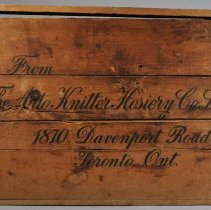
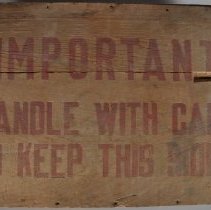
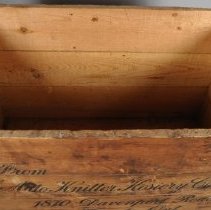
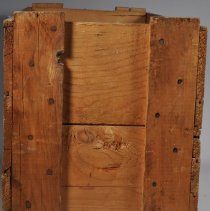
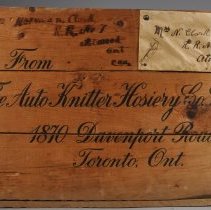
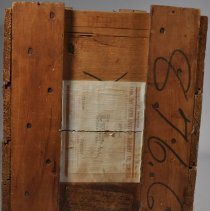
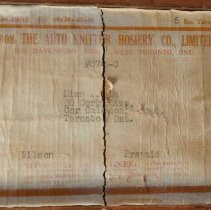
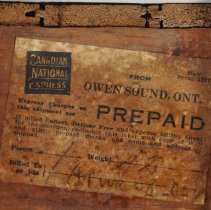
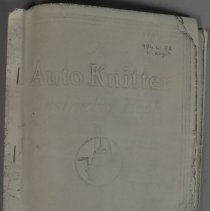
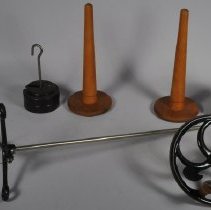
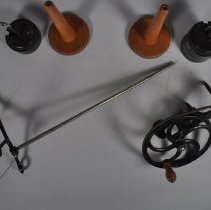
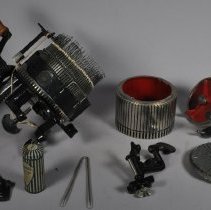
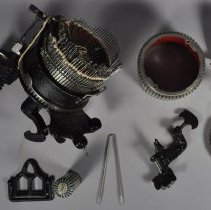
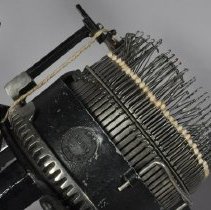
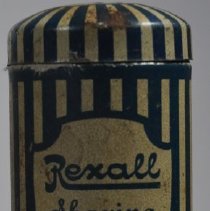
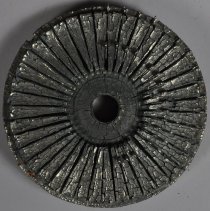
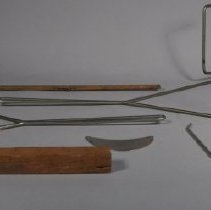
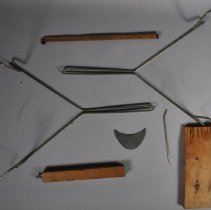
This is a disassembled AUTO KNITTER knitting machine in its wooden shipping crate, and accompanied with an instruction booklet (1925). It has a REXALL shaving stick printed tin with it as well, to help hold small parts. The shipping crate has black and red printing on it. It has affixed address labels on it. There is also a Canadian National Railway Express label on it from Owen Sound, Ontario. There is a folding ruler kept in the crate as well. There are two wooden yarn spools, a couple of black-finished metal hanging weights, and various parts. There are silvertone, black and red-finished areas. The crank handle of the knitting machine has a turned, medium-brown wooden grip handle. |
Provenance |
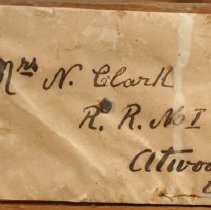
Originally shipped from Toronto, the item appears to have been used by more than one person. There is an address on it re a Mrs. N. Clark of RR#1 Atwood, Ontario, and one for a Miss ________, of Toronto. There is also a Canadian National Express label on it from Owen Sound, Ontario. Last owned by Thelma Kuglin (née Liscombe) of Williamsford, Holland Township, Grey County, who later brought it to Owen Sound, when she retired there. |
Collection |
Textiles, Needlework & Accessories Collection |
Material |
Wood/Metal/Paper/Ink/Glue |
Found |
Owen Sound, Grey County |
People |
Kuglin, Thelma |
Subjects |
Knitting |
Search Terms |
Canadian National Railways (C.N.R.) |
Function |
A factory-made, manual knitting machine, and its shipping crate. The company shipped knitting machines to various people (often women) in Canada via trains. It was a way for people to earn a wage cheque by producing socks and other knitted goods at home and sending them to Toronto. The knitting machine was hand-cranked, intended for home use, and made seamless hosiery. The operator only had to add a few hand stitches to close the toe of a stocking. The machine could also be used for sweaters, scarves, caps, underwear, mittens, and baby sets. The company had a contract saying that they would purchase standard socks for $1.50 per dozen pairs, and that they would replace the yarn. Circa 1926, they were advertised as "A Money Maker in the Home". |