

Object Record
Images
Metadata
Object ID # |
2018.033.001 |
Object Name |
Ornament, Mourning |
Other Name |
Penny, Death / Plaque, Memorial |
Title |
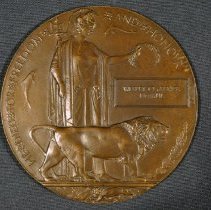
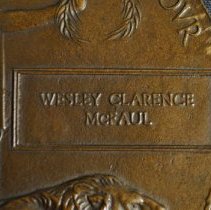
Memorial Plaque of Lt. Wesley Clarence McFaul |
Date |
1921 |
Year Range from |
1921 |
Year Range to |
1921 |
Artist |
Woolwich Arsenal |
Made |
Woolwich Arsenal (England) |
Place of Origin |
England, United Kingdom |
Description |
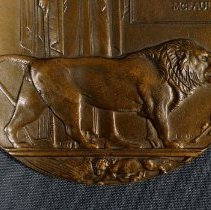
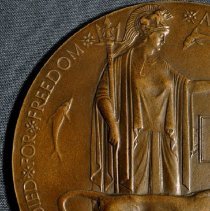
A bronze memorial plaque (nicknamed the Death Penny) commemorating the sacrifice of Wesley Clarence McFaul. Britannia holds a trident in her right arm and a laurel wreath in her left hand above his name, which does not provide his rank, as all of the men who died in the war were considered equal in death. The British lion stands underneath his name, above the symbols of the enemy. The legend is "HE DIED FOR FREEDOM AND HONOUR". Two porpoises swim in the upper background. |
Makers mark |
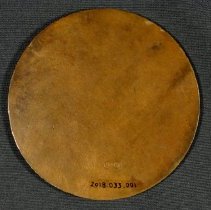
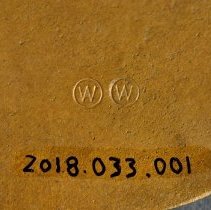
It has two encircled W impressed marks on the back, stamped side-by-side. |
Provenance |
Made at the Woolwich Arsenal at 54/56 Church Rd., Acton W. 3, England. Lieutenant W. C. McFaul was born in Owen Sound, Grey County, on March 27, 1891. He was killed on the last day of the First World War, November 10, 1918, at Mons, Belgium. The next day, November 11, 1918, was the Armistice. He was usually known as "Clarence" by family and friends. His next-of-kin was his father, Alexander Wesley McFaul, who had a grocery store in town. Owen Sound citizens who had lost a family member to the conflict received their Memorial Plaques in September, 1921. This item was passed down to one of Lieutenant McFaul's brothers, Robert Cecil McFaul. It was last kept by Cecil's son, Robert Wesley McFaul. |
Collection |
Military, 20th-c Collection |
Material |
Bronze |
Dimensions |
D-0.4 Dia-12 cm |
Found |
Sauble Beach, Bruce County |
People |
McFaul, Wesley Clarence |
Subjects |
World War I (First World War/The Great War) Memorial works Soldiers |
Search Terms |
19th Battalion |
Function |
As the bodies of the war dead were not re-patriated to Canada, these tangible mourning pieces were sent to the grieving next-of-kin. They were nicknamed "Death Pennies". The Next of Kin or British Memorial Plaque is a bronze plaque approximately 11 cms or 4½ inches diameter with the name of someone who died serving with the British and Empire forces in the First World War. This was issued to the Next of Kin of the casualty along with the scroll. They were posted out separately, typically in 1919 and 1920, and a ‘King’s message’ was enclosed with both, containing a facsimile signature of the King. Who might have received the plaque, scroll and King’s message? The immediate next of kin of all who died serving with the British and Empire forces in the First World War were eligible to receive the plaque and scroll. With nearly a million dead for the British Army alone, the plaques are today still commonly found; the fragile scrolls survive less often. Some of those recorded by plaques and scrolls were not eligible for service medals, for instance, those who did not serve overseas but who died in service through accident or illness. Deaths in the period 1919–1921 (possibly later) could still lead to the presentation of a plaque, if either still in service (and even from natural causes), or the death was accepted as war-related. It is thought that many British and Empire war dead had no plaques and scrolls issued, due to the inability by 1919–20 to trace addresses for the eligible next of kin – a result of the high incidence of short-term rented addresses, re-marriage, and that, if they died unmarried with parents dead, there might be no dependants claiming a pension. What was the purpose of the plaque, scroll and message? The plaques and scrolls were produced to commemorate those that gave their lives and acknowledge their sacrifice. They were intended to give the close family a tangible memorial of their lost loved one. |