

Object Record
Images
Metadata
Object ID # |
1961.064.049abcdefghijklm |
Object Name |
Trephine |
Title |
19th-Century? Trephination Set |
Lexicon category |
5: T&E For Science & Technology |
Date |
19th-century |
Made |
Unknown |
Place of Origin |
Great Britain? |
Description |
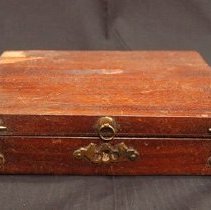
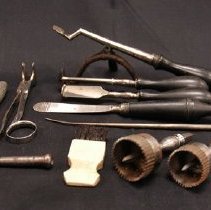
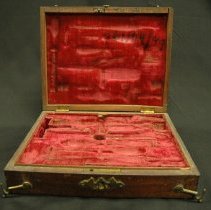
Cased trephine set, likely 19th-c (for operating on the cranium) consisting of the box (a) and 12 primarily metal and wood instruments from b to m (all but "m" are marked). Storage Box: The wooden box is rectangular and veneered, with dove-tail joinery. There are two hook and eye catches to fasten it. The catch has a rectangular eye, suggesting that it is an older item. There is a brass keyhole escutcheon and a brass lift ring (on the lid). The lid has two brass hinges. The interior of the lid has red plush material lining it. The bottom interior of the box has red plush-lined recesses, which are structured to hold the instruments in order during storage or transport. There are no labels on the box to suggest who the manufacturer was. It is 19 cm x 24 cm x 6 cm. B. Cannula (or Canula): A tube that is inserted into a cavity in order to drain out internal fluids. A non-magnetic, tapering metal tube with reeded sides, 6.6 cm long, with diameters of 1 and 0.8 cm C. Levator: A levator is a surgical instrument used to raise a depressed part in a skull fracture. It is used in conjunction with "M". It has a turned, ebony wood handle. 16.5 cm long. The cranked working end has a circular, ridged shape. D. (Function Unknown, perhaps a probe or drain item?). Non-magnetic metal item. There is a tapering tube, which bends slightly at one end. The larger end is lipped.15 cm long. E. (Function unknown, possibly a levator item?): This item's ebony wood handle is shaped diferently from the other pieces--it has a key-like end, perhaps to improve one's grip? The blade is flat, with a ridged top at its end. The blade is slightly convex on its underside. 18 cm long, while the blade is 1.1 cm wide. F. Trocar (or Trochar): A surgical, sharp-pointed, tirangular-shaped instrument used with a cannula in order to drain off internal fluids. It is steel with an ebony wood handle.-13.5 cm long. At a right angle to the shank of the handle is a five-sided bevellled pick which is 2.8 cm x 1.5 cm. It has a very sharp edge to it. G. (Function Unknown). This item is steel, with an ebony wood handle. It is 13 cm long, and approx. 1.5 cm wide. There is a bevelled surface. The blade end is capped with a convex, circular part which is 1.5 cm in diameter. H. Forceps: The forceps are steel, with slightly-bowed handles. One handle has a closed finger hole grip, while the other one has an open curved end for twisting. The fulcrum area on one side has something impressed which looks like "W" and "FE S". The blades are bowed and short. There are knurled and raised dot gripping surfaces on the inside. I. Brush: Natural black bristles, all cut to the same length with a short bone or ivory handle, which is 5.2 cm x 2.3 cm, and shaped so that it is easy to grip. J. [Not sure what it is called] steel item that is round and key-shaped, 6.2 cm long, 3 cm wide. It has incised triple ring decoration in two places. K. Toothed bit (larger of two): length of 7.5 cm, diameter of 2.8 cm, has a tapered, turned look, steel, the boring end is very sharp. Would it be called a cranial drill? L. Toothed bit (smaller of two): length of 7.5 cm and a diameter of 2.5 cm. Would it be called a cranial drill? M. Tripod: This steel item's pivot join matches "C". The sides are curved and footed and covered with black suede or felt? that is tightly sewn on it. The tripod is 4 cm high and is 7.3 cm wide (between the two parallel legs). The set is missing a turnkey-type piece (likely used for turning the bits?). Its outline is discernable from its empty storage space. |
Makers mark |
No label or logo seen on the box, the "H" item has a mark on it that needs research |
Provenance |
Last owned by Beatrice McDonald (neé McKinley). It is not known how she acquired this very old trephination set, which would have been something a doctor/surgeon would have kept. She grew up in Bognor, Sydenham Township, Grey County. Her father, William McKinley, was a blacksmith there. Her mother was Mary Penner of Grey County. They later moved to Holland Centre. Beatrice McDonald later lived at Chatsworth, Grey County. She likely was also related to Wm. McKinley Sr. (b. 1819 in Scotland) and his wife Beatrice McKinley (b. 1829 in Scotland). This older couple had emigrated in 1856. They too were in the 1901 census, as were her parents. |
Collection |
Medical/Dentistry, 19th-c Collection |
Material |
Wood/Metal/Brass/Natural Bristles |
Dimensions |
H-6 W-24 L-19 cm |
Found |
Grey County, Ontario |
People |
McDonald, Peter McKinley, William McDonald, Beatrice Henry, Dr. E. |
Subjects |
Surgical instruments Surgery Medical equipment & supplies Skulls |
Search Terms |
Bognor Holland Centre |
Function |
Trephining or trepanning is a surgical procedure for fractured craniums. This procedure was done in order to access and elevate bone (as well as remove bone and blood clots) so as to reduce pressure on the brain. A trephine is a crown saw used for removing a piece of bone from the cranium. |