

Object Record
Images
Metadata
Object ID # |
1961.013.031ab |
Object Name |
Teacup |
Title |
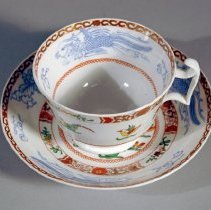
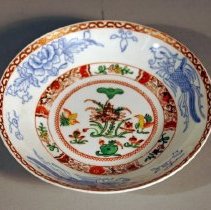
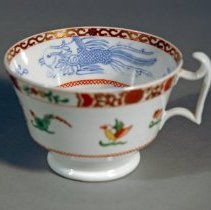
"Italian Pattern" Spode Tea Cup & Saucer |
Lexicon category |
4: T&E For Materials |
Date |
Likely 1790 |
Made |
Spode |
Place of Origin |
England, United Kingdom |
Description |
A SPODE tea cup and saucer with the Italian pattern (1790). The underside of the cup has a blue transfer-printed "Spode" mark, and a hand-painted "2638" mark (=pattern number). The saucer is similarly-marked on its underside. |
Makers mark |
The underside of the cup has a blue transfer-printed "Spode" mark, and a hand-painted "2638" mark (=pattern number). The saucer is similarly-marked on its underside. |
Provenance |
Likely originally belonged to Jeanette Jenkins, (née Jeanette or "Jessie" Gunn), who was born in Sydenham Township in 1851. She had a twin sister, Margaret "Maggie" Gunn (later Mre. James L. Boyd). They were daughters of Marcus and Barbara McKay of the Woodford area of Sydenham Township, Grey County, who were Scottish settlers. Jeanette Jenkins died in May of 1900. Her husband was Herbert William Jenkins and was born in Nottingham, England in 1851. He was the Principal at the Owen Sound Collegiate Institute high school (O.S.C.I.) from 1893-1902. He died in Winnepeg, Manitoba in 1941. The last owner, Jeanette Jenkins' daughter, Eva E. Jenkins, was born circa 1880, and likely was born and raised in Winnipeg. She had a brother and a sister. The accession card suggests that she thought the English-made cup and saucer to be made by Spode in 1790. SPODE [Spode-Copeland] Josiah Spode (1733-1797) came of a long line of Staffordshire potters. After his apprenticeship, he eventually took over the former firm of Turner & Banks, whose works were on the nine-acre site that eventually became the Spode-Copeland site. Transfer-printing allowed Spode to keep his wares low in price, and aided his prosperity. His chief engraver was William Greatbach, and the designs were executed by Thomas Minton. Spode produced wares for both home and overseas markets. For many years, he experimented with white ash from calcined bone in hopes of producing a translucent porcelain. He eventually produced "bone china". Some of the Spode patterns were influenced by Chinese and Japanese motifs seen on tea boxes and papers which came west via the East India Company. Spode pieces have been marked with the name from 1770 onwards. [Trimble] Early Spode wares just had "Spode" marked on them. The name and pattern number appeared on the bottom of their earthenware and porcelain circa 1790-1820. The number changes with each pattern. Godden's book suggests that the printed Spode mark was used c. 1805+ on porcelains (earthenwares were marked c.1784+) "For the beginning of the story of under-glaze printing on British earthenware, it is necessary to go back to Staffordshire's Josiah Spode....He did not himself invent the technique, nor was he even the first to try it out in Staffordshire...At his factory, carried on by his son after his death, under-glaze printing was brought to perfection...Much of the prosperity of nineteenth-century Staffordshire was _____ on what Josiah Spode did at the end of the 1770's." [Collard] - - - Collard, Elizabeth, NINETEENTH CENTURY POTTERY & PORCELAIN IN CANADA, Montreal, McGill University Press, 1967, p. 121. Godden, Geoffrey A., ENCYCLOPAEDIA OF POTTERY & PORCELAIN MARKS, London, Herbert Jenkins, 1964, p. 589. Hayden, Arthur, SPODE AND HIS SUCCESSORS, printed in England, Heaton, Mersey. Trimble, Alberta, MODERN PORCELAIN, 1962, see chapter 45. |
Collection |
Food Service Tools & Equipment |
Material |
Ceramic/Glaze/Transfer Print/Paint |
Dimensions |
D-5.8 Dia-14.4 cm |
Found |
California, United States of America |
People |
Jenkins, Eva Jenkins, Jeanette (Jessie) Gunn, Marcus |
Subjects |
Tea Tableware |
Search Terms |
Sydenham Township |
Function |
This is part of an English-made tea set. See RELATED for matching items. |