

Object Record
Images
Metadata
Object ID # |
2003.019.009 |
Object Name |
Pick, Mill |
Title |
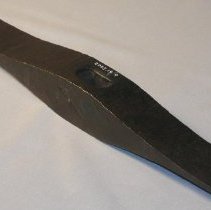
Mill Pick Head from Hemstock's Mill |
Lexicon category |
4: T&E For Materials |
Year Range from |
1888 |
Artist |
W. & J. G. Greey |
Made |
W. & J. G. Greey |
Place of Origin |
Toronto, Ontario |
Description |
The head of a gristmiller's hand tool, called a "millstone furrow pick". It is factory-made, shaped steel tool, with two symmetrical working ends (4.2 cm wide). It is 4 cm thick at the middle and has an ovoid eye for the wooden handle (now missing). The handle would have been called a thrift. The metal is impress-stamped with a couple of maker's logos on one side, while the other side has W. & J. G. GREEY stamped. This company is listed in an 1894 source as a Toronto manufacturer of milling equipment, established in 1888. |
Makers mark |
The metal is impress-stamped with a couple of maker's logos on one side, while the other side has W. & J.G. GREEY stamped. |
Provenance |
Made by a milling equipment manufacturer called "W. & J. G. Greey" of Toronto. Belonged to John T. Hemstock who owned and operated the Hemstock mill near Chatsworth, Grey County. He was a great-grandson of Adam Scott Elliott, who built the Sullivan Mills in Grey County the 1850s. The mill was J. T. Hemstock's property until c.1960, and then it was owned by his son, John MacKinnon Hemstock. It is unknown where the stick came from, or when it was first obtained. It very likely was used by Adam Scott Elliott. Last owned by Mrs. Lois Challinor Hemstock of Kitchener, Ontario. |
Collection |
Milling Tools & Equipment Collection |
Material |
Metal/Steel |
Dimensions |
W-4.2 L-30 D-4 cm |
Found |
Ontario |
People |
Hemstock, John Thomas Elliott, Adam Scott |
Subjects |
Gristmills Grey County Industry Grey County Industries Sullivan Township |
Search Terms |
Hemstock's Mill |
Function |
A hand tool, used by a gristmiller to "dress" the furrows of a millstone. This example was used at Hemstock's Mill in Grey County. Millers needed to "dress" their millstones in grist mills in order to keep the grinding surfaces efficient. They used metal and wood hand tools to do this work. |