

Object Record
Images
Metadata
Object ID # |
2003.019.001 |
Object Name |
Rule, Log |
Title |
Board & Log Measure |
Lexicon category |
4: T&E For Materials |
Date |
c. 1879 |
Made |
Unknown |
Place of Origin |
Unknown |
Description |
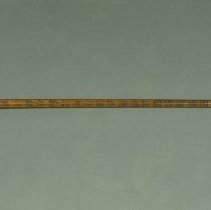
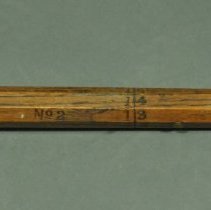
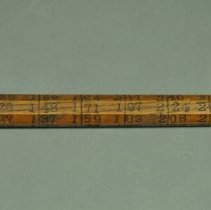
Wooden board and log measure. This is an octagonally-shaped measuring stick. It has impressed calibrations / numerals over most of its surfaces. The manufacturer is not identified, but there is "No. 2" impressed in the wood. One end (the head) has a circular, convex cast brass piece affixed with a flat, slotted screw. The other end (the tip) is worn and pointer-like. The rest of the stick was referred to as the "cane" in the 19th-century. - - - |
Makers mark |
"No. 2" impressed |
Provenance |
Manufacturer unknown. Belonged to John T. Hemstock, who owned and operated the Hemstock mill near Chatsworth, Grey County. He was a great-grandson of Adam Scott Elliott, who built the Sullivan Mills in Grey County the 1850s. It was likely used by Adam Scott Elliott and passed down to John. Last owned by Mrs. Lois Challinor Hemstock of Kitchener, Ontario. |
Collection |
Lumbering/Logging Tools & Equipment Collection |
Material |
Wood/Brass |
Dimensions |
L-36.85 Dia-1.181 inches |
Found |
Ontario |
People |
Elliott, Adam Scott Hemstock, John Thomas |
Subjects |
Sawmills Timber Grey County Industry Grey County Industries Sullivan Township |
Function |
A log rule was a measuring tool used in the lumber industry to estimate the amount of usable lumber (board feet) that could be sawn from a log. It typically consisted of a long stick or scale marked with measurements and conversion tables. Here’s how it worked: The user measured the diameter of the log (usually at the small end) and sometimes its length. Using the markings or tables on the rule, they could quickly calculate the board-foot volume based on standard formulas. Log rules were essential for: Timber sales – determining the value of logs before cutting. Inventory and scaling – estimating yield for mills and buyers. |