

Object Record
Images
Additional Images [1]
Metadata
Object ID # |
2014.035.007 |
Object Name |
Chair, Office |
Title |
C.N.R. Telegraph Operator's Chair |
Date |
Early 20th-century |
Year Range from |
1918 |
Year Range to |
1960 |
Made |
Unknown |
Place of Origin |
Canada |
Description |
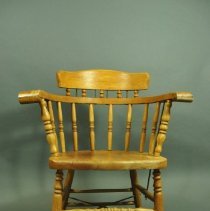
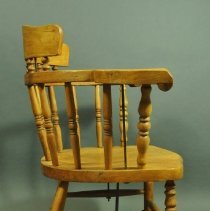
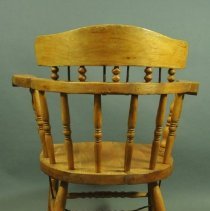
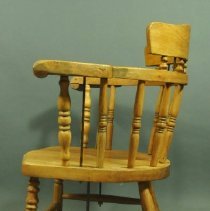
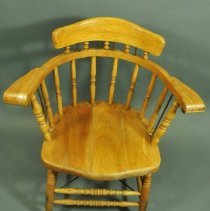
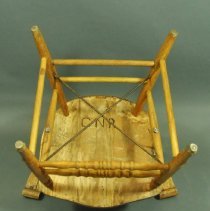
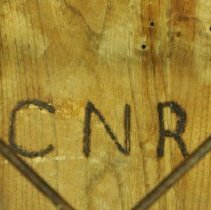
Refinished wood and metal chair. It has a light finish, and the initials "CNR" incised and dark-finished on the underside of the shaped seat. It has a curved back rest and a curved cresting rail supported by short turnings and vertical metal rods. The two front legs are turned and support wooden arm rests. Two vertical rods also support the arms. The side and back legs are plain, and have two plain stretchers set in three directions. The two front stretchers are decoratively turned. The underside of the chair is reinforced by a crossed X-frame made of metal rods secured by nuts. Some peg joinery is also visible in the armrest areas. The piece was likely stripped of its original finish. It was built using slotted, flat-headed screws. Some of the hardware pieces appear to be more recent. The undersides of the feet have brass pieces affixed to then. No maker's label observed. |
Makers mark |
No furniture factory mark, but the underside of the seat is incised/impressed with CNR in large letters. |
Provenance |
Manufacturer unknown. Dates to the early 20th-century. Allan Nicholson told museum staff that it belonged to the telegraph operator of a Canadian National Railways train station in Paisley, Ontario. Last owned by Allan Nicholson of Palmerston, Ontario. He acquired vintage railway equipment at auctions and sales in Grey and Bruce counties. |
Collection |
Transportation, Railroad Equipment Collection |
Material |
Wood/Metal/Finish |
Dimensions |
H-32.48 W-27.559 D-20 inches |
Found |
Ontario |
Subjects |
Chairs Railroad stations Railroads |
Search Terms |
Canadian National Railways (C.N.R.) |
Function |
An office chair. Sometimes chairs of this stying were also used in bars. The curved back was intended to make it more comfortable than a straight-backed chair. This chair was identified as C.N.R. property, so that it would not be removed from the C.N.R. station where it was used. It was formerly used by the telegraph operator(s) who worked at the Paisley, Ontario train station. The metal rods were used in the chair's design to provide extra durability and bracing. |