

Object Record
Images
Metadata
Object ID # |
1995.005.001 |
Object Name |
Holder, Match |
Other Name |
Advertisement |
Title |
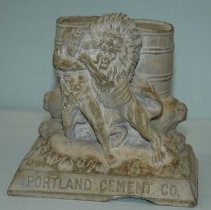
Advertising Ornament for "Samson Brand" Cement |
Lexicon category |
8: Communication Artifact |
Year Range from |
1892 |
Year Range to |
1908 |
Made |
Portland Cement Co. |
Place of Origin |
Grey County, Ontario |
Description |
Advertising ornament re "Samson Brand" cement (1892-1908). This ornament is cast with the figure of a male (Samson), being attacked by a male lion in front of two cement barrels. Around the base is "PORTLAND CEMENT CO." "OWEN SOUND" "SHALLOW LAKE" "SAMSON BRAND". The item has "A. E. Cordingley" marked on it. Someone also wrote "1880" on its base, but this is erroneous. |
Provenance |
This item dates from 1892-1908, when the Portland Cement Co. had a Shallow Lake cement plant. It was also called The North American Mining and Manufacturing Company. Shallow Lake's potential for Portland cement was discovered by Richard Judson Doyle. Prior to his death in 1903, he received a royalty for every barrel of cement that was made at the plant. The item belonged to A. E. Cordingley of Shallow Lake, Grey County. He had a general store there c. 1914. Not long before he died, he passed it on to Stewart Hunter (who owned Hunter's Hardware in Wiarton, Bruce County). Mrs. Hunter was a sister of Gertie Greig and Mrs. Hunter gave it to Gertie, who gave it in turn to her son-in-law, Arnold R. Clark of Owen Sound, Grey County. |
Collection |
Commercial Equipment Collection |
Material |
Cement? |
Dimensions |
H-4.528 W-4.921 L-3.622 inches |
Found |
Owen Sound, Grey County |
People |
Cordingley, A. E. Doyle, Richard Judson Butchart, Robert Pim |
Subjects |
Lions Grey County Industries Owen Sound Industries Cement industries |
Search Terms |
The North American Mining and Manufacturing Co. (Shallow Lake) |
Function |
Commercial enterprises sometimes would order or make advertising give-aways that could be given to and kept by clients or customers. This one advertises a cement product manufactured in Grey County. At that time, cement was usually shipped in barrels. |